




Moisture Damage Survey
Our experts evaluate moisture levels and provide actionable solutions to safeguard your property. Schedule your survey now.

When is a moisture damage survey needed?
- Floor screeds and concrete slabs. Moisture testing before laying resilient flooring, timber, or laminate to confirm the substrate meets the required ERH threshold and avoid post-installation failure – adhesive failure, cupping, buckling, or void formation beneath the finish.
- New build and renovation projects. Assessment of moisture levels in blockwork, plasterboard, insulation, and other materials installed before a structure has fully dried out. Particularly important where building work has been accelerated or where materials have been exposed to weather during construction.
- Exposed building shells. Properties left unroofed or open to the elements during construction, or following storm damage or flood, where moisture levels in the structural fabric need to be established before internal works resume.
- Insurance and dispute documentation. Independent moisture readings to support insurance claims or to resolve contractor disputes over flooring or material failures where documented evidence of substrate condition at a point in time is required.
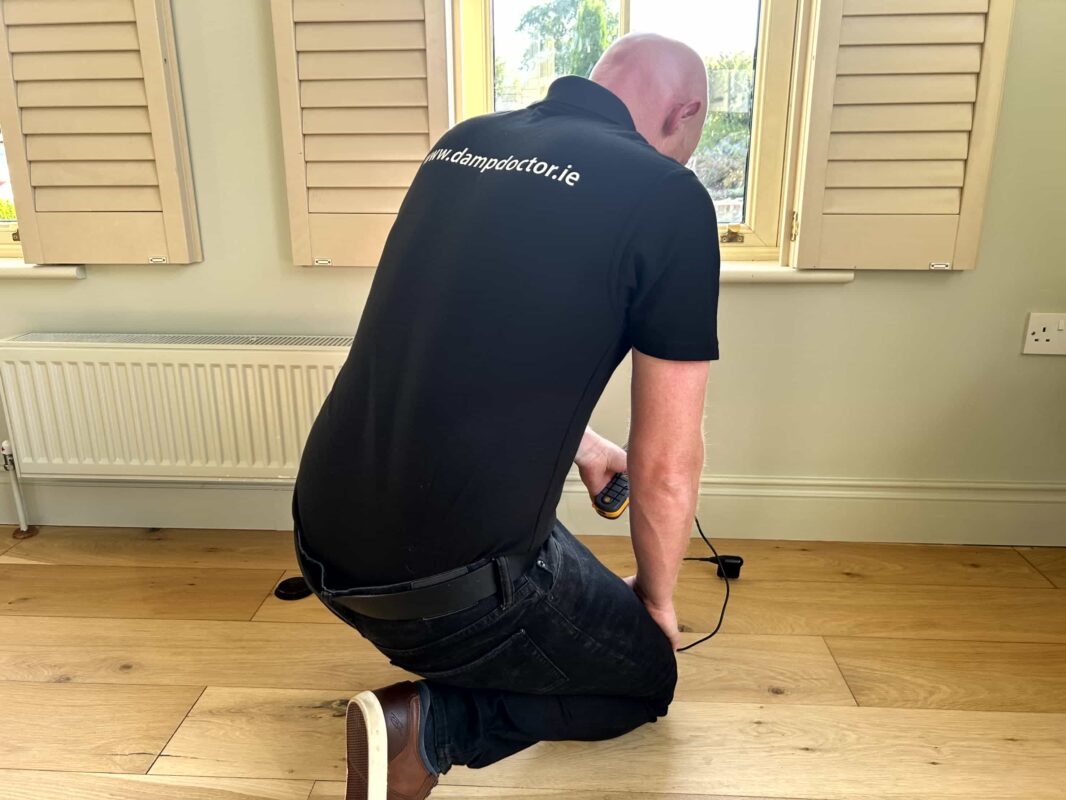
A moisture damage survey is a professional assessment of moisture levels within building materials – concrete slabs, floor screeds, blockwork, plasterboard, and timber – carried out to determine whether a structure is sufficiently dry before finishes are installed, works resume, or a building is handed over. It is primarily used by builders, contractors, developers, and project managers who need documented moisture readings to support installation decisions or insurance and dispute-related claims. Dampdoctor’s moisture damage surveys are carried out by professionally qualified building surveyors and engineers and produce written reports suitable for use by flooring contractors, architects, project managers, and insurers. If you are dealing with existing damp in a residential or commercial property rather than construction moisture, our comprehensive damp survey is the appropriate service.
Option A is the appropriate choice for surface and shallow moisture assessment of plasterboard, timber, and wall materials. Option B – which uses humidity sleeves – is required for in-depth concrete and screed testing where flooring installation decisions or manufacturer warranties depend on the result.
The standard Moisture Damage Assessment Survey is perfect for identifying surface-level moisture issues in materials like plasterboard and wood, using advanced tools that provide precise and non-invasive results.
The Premium Moisture Damage Survey offers in-depth testing, including humidity sleeves for concrete assessments and preparation for flooring installations, with comprehensive reporting to guide project continuation and ensure long-term success.
The in-situ relative humidity (RH) sleeve method involves drilling a hole into the concrete or screed at the required depth, inserting a sealed sleeve, and leaving it for 24–72 hours to allow moisture to reach equilibrium within the sleeve before an RH probe reading is taken. This method measures moisture content at depth – typically at 40% of the slab depth as required by BS 8203 – rather than just at the surface, giving a reliable assessment of whether the substrate is genuinely dry throughout. It is required when a flooring contractor or manufacturer specifies an in-situ RH reading as a condition of their warranty, or when surface meter readings alone are insufficient to satisfy an insurer or project specification.
| Standard Survey | Premium Survey | |
|---|---|---|
| Completed by Qualified Building Surveyors & Engineers |  |
|
| Proven Surveying & Engineering Techniques | |
|
| Pinless Moisture Detection (up to 20mm) | |
|
| Pin Function for Wooden Materials | |
|
| Thermal Imaging for Moisture Detection | |
|
| Assessment of Plasterboard, Studs & Ceilings | |
|
| Professional Written Report | |
|
| Concrete Humidity Testing (up to 50mm) |  |
|
| Preparation for Laminate Flooring Projects | |
|
| Advanced Testing with Humidity Sleeves | |
|
| Detailed Reporting for Project Continuation and Installation Decisions | |
|
| Book Now | Book Now |
The written report includes RH percentage readings at specified depths, the testing method used, photographic evidence of test locations and conditions, and a clear pass/fail assessment against the 75% ERH threshold specified by BS 8203 for most resilient floor coverings (and the equivalent threshold under BS 8201 for timber flooring). The report is formatted for use by flooring contractors, architects, project managers, insurers, and dispute resolution processes – providing the documented evidence of substrate condition required to satisfy warranty or insurance requirements.
All moisture readings are assessed against industry-standard ERH thresholds – typically 75% relative humidity or below for most resilient floor covering installations (BS 8203) and timber flooring (BS 8201).
Our Customer Reviews
Frequently Asked Questions
Before any moisture-sensitive finish is installed - flooring, tiling, plasterboard, insulation, or fitted joinery. The earlier a problem is identified, the less disruption and cost is involved in resolving it.
The sleeves are drilled and sealed on the first visit. They are then left for a minimum of 24 hours - typically 72 hours for most accurate results - before a second visit to take the RH probe reading. The written report follows within a few working days.
For most resilient floor coverings, the substrate must be at or below 75% relative humidity (ERH) as specified by BS 8203. For timber flooring the threshold is similar under BS 8201. Some manufacturers specify tighter tolerances - always check the product specification before proceeding.
Yes. A Dampdoctor moisture damage survey report provides documented, independently verified moisture readings with photographic evidence and a clear methodology. This is the standard of evidence typically required by insurers and dispute resolution processes.
A damp survey investigates moisture problems in an existing occupied property - identifying rising damp, penetrating damp, or condensation and recommending remediation. A moisture damage survey measures absolute moisture levels in building materials as part of a construction or renovation process, to determine whether a structure is sufficiently dry before works proceed. See our comprehensive damp survey if you have a damp problem in an existing property.
If you need surface readings of walls, timber, or plasterboard, Option A is suitable. If you need in-depth concrete or screed testing - for flooring installation, a manufacturer warranty, or an insurance claim - Option B using humidity sleeves is required. If you are unsure, contact us and we will advise before booking.
Book Your Survey
Enter your details into the form below and we will be in touch to arrange for your damp survey.
Why Choose Dampdoctor?

Efficient service from the beginning
No obligation survey
Surveys carried out by experienced surveyors
Honest, professional advice
Competitive prices on our range of solutions


A Full Range Of Solutions Across All Sectors
We are the preferred provider across the residential, commercial & state / semi-state sectors because of the qualifications, unique training and experience of our surveyors and team. Let us help you do it the right way.