






Dublin’s Georgian buildings are some of the finest in Europe. The terraces of Merrion Square, Fitzwilliam Square, Mountjoy Square, and the North Circular Road represent an extraordinary piece of the city’s architectural heritage. They are also, almost without exception, buildings that require careful management when it comes to moisture.
Damp is not inevitable in a Georgian property — but it is common, and it is frequently misunderstood. The construction methods used in the Georgian era create a specific damp profile: particular vulnerabilities, particular failure points, and particular mistakes that well-meaning owners and contractors make when trying to fix them. Getting the diagnosis right is everything.
How Georgian Buildings Were Built — and Why It Matters for Damp
Georgian buildings in Dublin were typically constructed with solid brick or stone walls, lime-based mortars, and breathable plasters. There was no cavity. There was no modern damp proof course. Moisture management relied entirely on the breathability of the materials: walls absorbed moisture during wet periods and released it again when conditions allowed.
This system works — when it’s left intact. The problem is that generations of refurbishment, renovation, and energy upgrading have often replaced breathable materials with impermeable ones, fundamentally disrupting how these buildings manage moisture. Understanding this is the starting point for understanding damp in Georgian Dublin.
The Most Common Damp Problems in Georgian Dublin Homes
1. Rising Damp
Rising damp is one of the most frequently seen issues in Georgian properties. These buildings either predate damp proof courses entirely or were built when DPC installation was inconsistent. Ground moisture travels upward through porous masonry by capillary action, and without a functioning barrier to stop it, it can rise to significant heights — particularly in wet conditions.
The typical signs of rising damp in a Georgian property include:
- Tide marks on lower walls, typically up to around one metre
- White salt deposits (efflorescence) on plaster or masonry surfaces
- Blown, bubbling, or deteriorating plaster at low levels
- Decay in skirting boards or embedded timber floor joists
- A persistent damp or musty smell at ground floor level
It’s important to note that these signs can also be caused by other mechanisms. Salt staining, for example, can result from penetrating damp as much as from rising damp. This is why visual diagnosis is unreliable and physical testing by a qualified surveyor is essential.
2. Penetrating Damp
Solid walls offer no cavity to interrupt the passage of rainwater. In Dublin’s climate — with persistent rainfall and frequent wind-driven rain — this makes external wall condition critical. Any defect in the external envelope of a Georgian building becomes a potential water ingress point:
- Cracked or eroded render on exposed elevations
- Failed or open pointing in brick or stonework
- Defective parapet or chimney stack details
- Blocked or leaking rainwater goods (gutters, downpipes)
- Failed flashings around chimney bases or roof junctions
- Gaps around window frames and reveals
Penetrating damp typically presents as localised patches that worsen noticeably after rainfall. Staining tends to appear around window heads, chimney breasts, or at high level near parapets — following the water’s path from the defect downward.
The correct remedy is always to identify and repair the external defect. Applying waterproof paint or sealant to the internal surface does not stop water entry — it redirects it, often causing more damage deeper in the wall fabric.
3. Moisture Trapped by Modern Finishes
This is perhaps the most distinctive and damaging damp problem specific to Georgian buildings — and one of the most common causes of accelerating deterioration in Dublin’s historic housing stock.
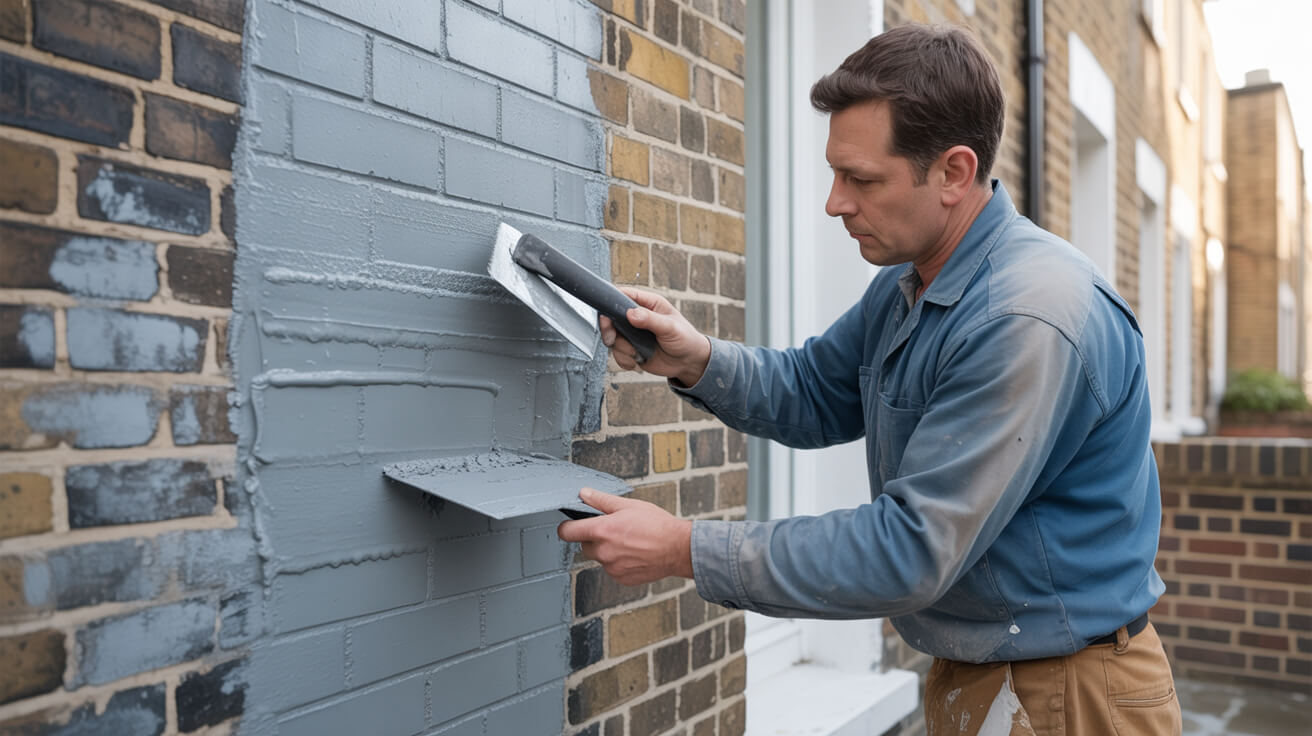
When a breathable lime-built wall is coated with cement render, sealed with modern impermeable plaster, or treated with waterproof paint, moisture that would naturally evaporate through the wall surface becomes trapped. It has nowhere to go except further into the wall fabric, or sideways into adjacent areas.
The result is typically:
- Plaster failure that recurs even after replastering
- Accelerating deterioration of the masonry behind impermeable coatings
- Salt contamination that migrates through the wall over time
- Damp patches that appear to move or spread unpredictably
If a Georgian property has had cement render applied — even decades ago — this is frequently a contributing factor in ongoing damp problems, and it must be factored into any survey and remediation plan.
4. Basement and Half-Basement Issues
Basement and half-basement spaces are a defining feature of Dublin’s Georgian terraces, and they carry their own distinct damp risks. Ground contact is direct, external ground levels are often higher than internal floor levels, and the wall-to-ground interface is complex.
Common basement damp issues include:
- Water ingress through floor slabs and lower walls
- Rising damp from ground contact
- Penetrating damp through external basement walls at or below ground level
- Poor drainage around the external lightwell or basement area
Basement damp in Georgian properties almost always requires specialist assessment — the mechanisms at play are more complex than in above-ground spaces, and incorrect treatment can cause significant structural damage.
The Mistake That Makes Georgian Damp Worse
The single most common mistake made in Georgian damp treatment is applying a solution without a correct diagnosis. This takes several forms:
- Injecting a chemical DPC into a wall suffering from condensation, not rising damp
- Applying waterproof render to a wall where moisture is already trapped behind it
- Replastering over salt-contaminated walls without treating the source
- Treating penetrating damp internally when the external defect is still present
Each of these not only fails to solve the problem — it can actively worsen it and cause secondary damage that is more expensive to repair. In a Georgian building with historic fabric, the cost of getting it wrong is particularly high.
A professional damp survey of a Georgian property will systematically assess external conditions, ground levels, basement details, and internal wall moisture using appropriate testing equipment — not just a visual walk-through.
Getting Damp Right in a Georgian Dublin Home
Georgian buildings can and do perform well when their moisture management is understood and respected. The priorities are:
- Maintain breathability — lime mortars, lime plasters, and breathable paints are appropriate for these buildings
- Keep rainwater goods clear and functional — blocked gutters and leaking downpipes are the most common source of preventable damp
- Monitor ground levels — raised paving or landscaping that bridges an existing DPC will cause rising damp
- Ventilate — sealing fireplaces and improving airtightness without adding ventilation raises indoor humidity and causes condensation
None of this replaces the need for a professional diagnosis when damp symptoms are present. The complexity of Georgian construction — and the layers of modification most properties have accumulated over two centuries — means that what you see on the surface reliably tells you very little about what’s actually happening in the wall.
Book a Damp Survey for Your Georgian Dublin Property
DampDoctor provides professional damp surveys across Dublin, with specific experience in historic and Georgian building stock. Every Dampdoctor survey includes our in-depth testing procedures, developed through decades of industry experience and grounded in proven surveying and engineering methodologies. This comprehensive approach allows us to accurately diagnose the root cause of damp and mould issues, providing homeowners and property professionals with clear, reliable findings and a detailed scope of works tailored to deliver long-term solutions.
Book your survey → DampDoctor Dublin Damp Solution
Read next in this series: – Damp Problems in Dublin: Why They’re So Common — Pillar Guide – Damp Problems by Dublin Building Era — Hub Page – Damp in Victorian and Edwardian Buildings in Dublin – Damp in 1930s–1950s Dublin Houses – Damp in Modern Dublin Apartments
